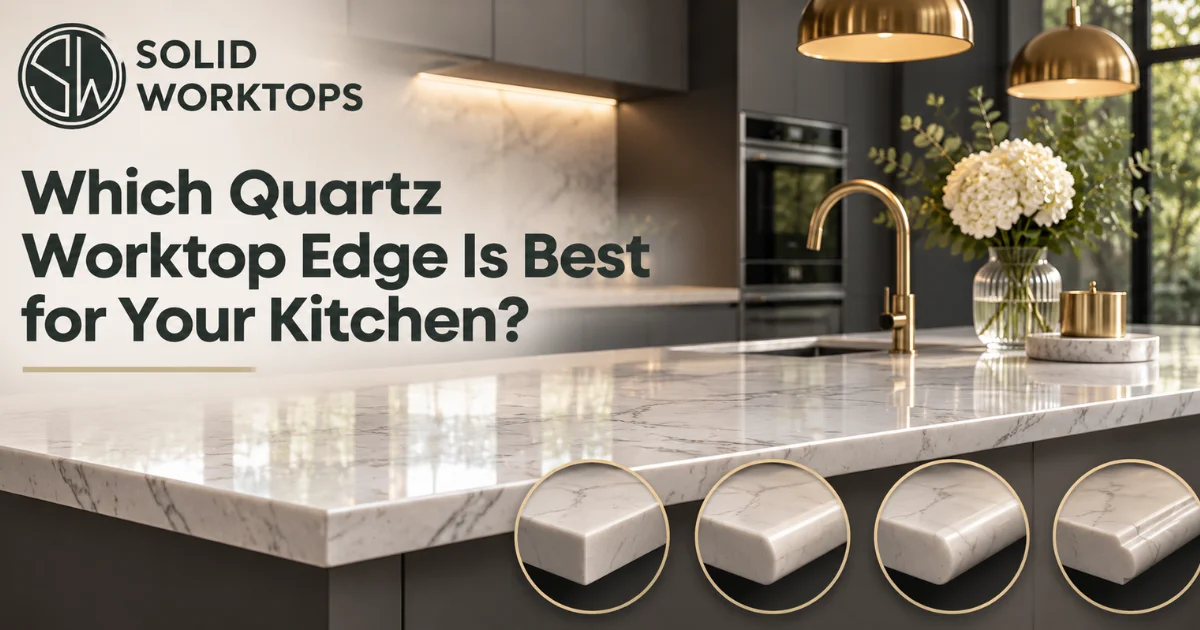
The best quartz worktop edge depends on your kitchen style, how you use the worktop and the finish you want. A square edge quartz worktop suits modern kitchens with clean lines, a rounded worktop edge softens the appearance of exposed corners, and a bevelled quartz edge adds a subtle decorative detail. An eased edge offers a similar straight appearance to a square edge but with its sharp aris slightly softened.
Before choosing, consider how the edge will look with your cabinets, whether children use the kitchen, how exposed the worktop corners are and whether your chosen profile affects the fabrication cost.
Different Quartz Worktop Edge Profiles
Quartz worktop edge profiles describe the shape and finish of the exposed edge of the worktop. Although the main surface may look similar across different kitchens, the edge profile can change the overall appearance considerably.
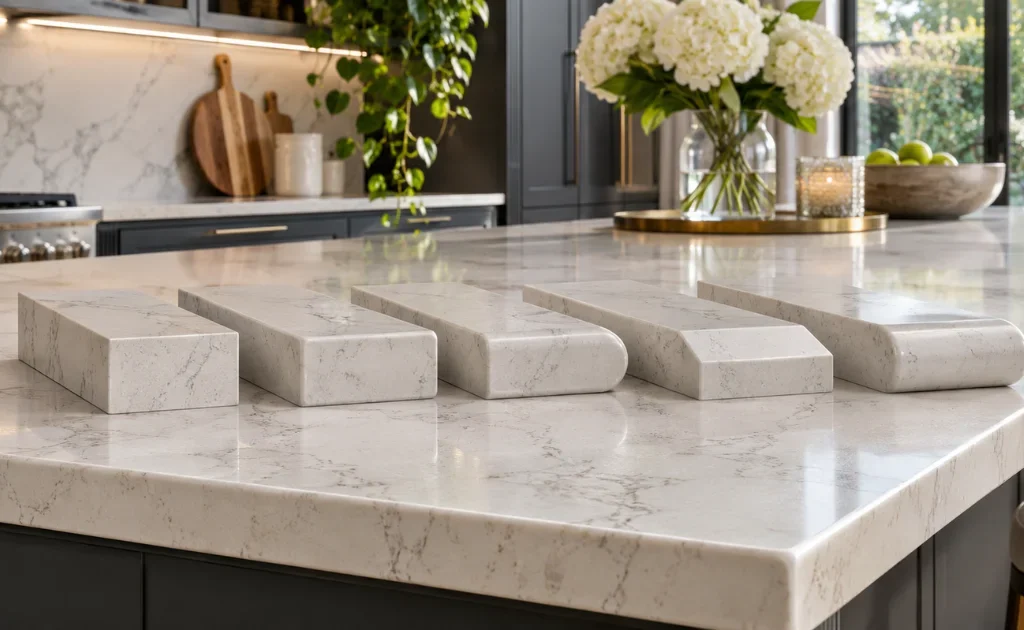
The most common options include square, eased, rounded, bullnose and bevelled edges. Each creates a different finish, so it is worth understanding the differences before ordering your worktop.
1. Square Edge Quartz Worktop
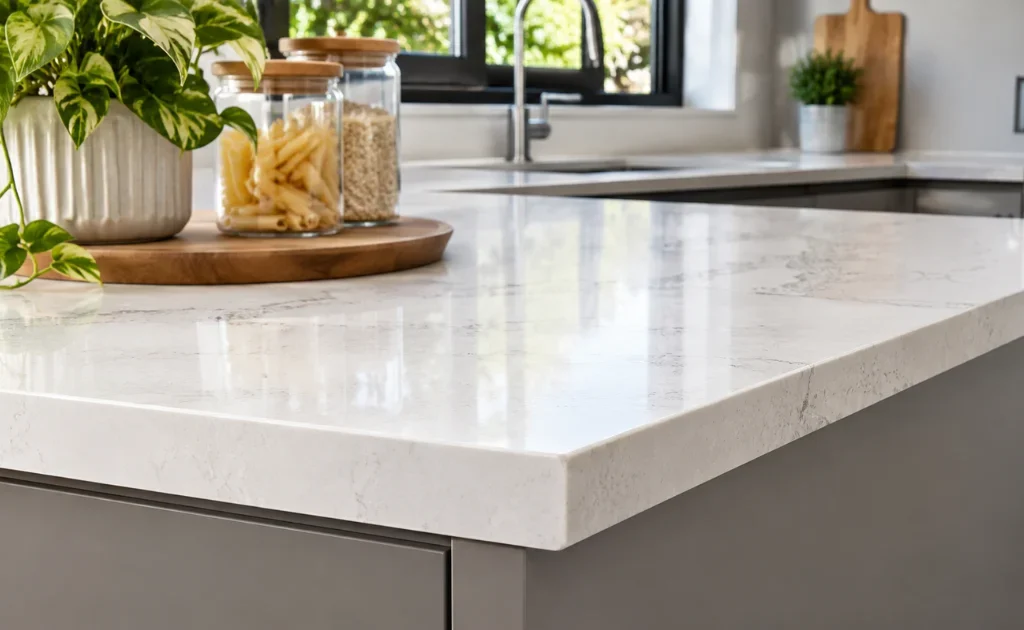
A square edge quartz worktop has a straight, angular appearance that suits contemporary kitchens. It creates a defined line along the front of the worktop and works particularly well with handleless cabinets, flat-fronted doors and minimalist interiors.
A square edge is a good choice if you want a clean, modern finish without an elaborate decorative profile.
What are the advantages of a square edge?
- A square edge creates a simple, uninterrupted line that works well with modern kitchen cabinets and contemporary worktop colours.
- It allows the quartz pattern to remain the main visual feature rather than drawing attention to a decorative edge.
- It suits many kitchen layouts, including perimeter worktops, islands and breakfast bars.
- Its relatively simple shape can be straightforward to specify, although fabrication requirements and pricing depend on the supplier and the exact finish.
Are square quartz worktop edges sharp?
Not necessarily. A square-profile worktop can have a slightly eased edge, meaning the fabricator softens the sharp arris while keeping the overall appearance straight.
This distinction matters because a perfectly sharp-looking edge in a photograph may not represent the precise finish supplied. Ask the fabricator whether the edge will be fully square or slightly eased.
Square edges can be vulnerable to impact at exposed corners, particularly if something heavy strikes them. This does not mean every square edge will chip easily, as the result also depends on the quartz product, fabrication, support and the force of the impact.
2. Rounded Worktop Edge
A rounded worktop edge has a curved finish rather than a sharply defined corner. The degree of curvature varies. A small pencil-round edge has a subtle curve, while a full bullnose profile has a more pronounced rounded shape.
Choose a rounded edge if you prefer a softer appearance or want to reduce the sharpness of exposed worktop corners.
What are the benefits of a rounded quartz edge?
- A rounded edge softens the transition between the worktop surface and its front face, making it suitable for kitchens where you prefer less angular detailing.
- A small rounded profile can complement traditional cabinets, shaker kitchens and many family kitchen designs.
- A rounded outside corner can reduce the sharpness of the corner that people may bump into when moving around the kitchen.
- A simple rounded profile is generally straightforward to wipe clean, although the precise shape and finish determine how easily you can reach every area.
Is a rounded worktop edge safer for families?
A rounded edge can reduce the sharpness of exposed corners, which may be useful in kitchens where children move around an island or breakfast bar. However, it does not eliminate the risk of injury.
If safety is a priority, consider the corner shape as well as the long front edge. A worktop may have a rounded profile along its front but still have projecting corners that need attention. Ask your fabricator whether the outside corners can also be rounded to suit your layout.
3. Bevelled Quartz Edge
A bevelled quartz edge has an angled section cut along the edge instead of a simple square or curved finish. Depending on the bevel’s size and angle, it can create a subtle detail or a more noticeable decorative line.
A bevelled edge is worth considering if you want something more distinctive than a plain square edge without choosing a fully rounded profile.
When does a bevelled edge work best?
- A bevelled edge can complement kitchens that combine traditional detailing with a more contemporary worktop finish.
- It can add definition to the front edge without requiring a large, rounded profile.
- It may suit a kitchen island where the exposed edge is a noticeable part of the design.
- It can work with different quartz colours, but the final effect depends on the bevel dimensions, slab thickness and pattern.
Before choosing this option, ask to see a close-up photograph or physical sample. A small bevel can look quite different from a deeper one, and the exact profile available depends on the fabricator’s equipment and the quartz product.
4. Eased Edge Quartz Worktop
An eased edge retains the straight appearance of a square profile but has its sharp arris slightly softened. This small adjustment creates a more comfortable finished edge without making the worktop look obviously rounded.
An eased edge is a useful option if you like the clean lines of a square quartz worktop but do not want the edge to remain perfectly sharp.
It can suit modern, traditional and transitional kitchens because it does not introduce a strong decorative detail. However, suppliers may use square edge and eased edge differently in their product descriptions, so confirm the exact finish rather than relying on the name alone.
5. Bullnose Quartz Worktop Edge
A bullnose edge has a more pronounced rounded profile than a small pencil-round edge. Depending on the design, the curve may extend across much of the edge’s depth, creating a softer overall appearance.
Bullnose edges can suit traditional kitchens and designs where the worktop is intended to have a more curved finish. They may also be considered for islands and breakfast bars where the front edge is highly visible.
However, a bullnose profile is not automatically more durable or easier to clean than every alternative. The suitability and cost depend on the exact profile, the quartz material and the fabrication required.
Square vs Rounded vs Bevelled Quartz Worktop Edges
Use this comparison to narrow down your options before asking a worktop supplier for samples or a quotation.
| Edge profile | Appearance | Best suited to | Main consideration |
| Square | Straight and angular. | Modern kitchens, handleless cabinets and minimalist designs. | Exposed corners can be vulnerable to impact. |
| Eased | Straight with a slightly softened edge. | Homeowners who prefer a clean, simple finish without a perfectly sharp arris. | Confirm how the supplier defines and finishes the profile. |
| Rounded | Softened and curved. | Family kitchens, softer interiors and designs with rounded details. | The degree of curvature varies between profiles. |
| Bevelled | Angled and subtly decorative. | Kitchens that need a little more detail along the worktop edge. | The bevel’s size and angle affect the final appearance. |
| Bullnose | More fully rounded. | Traditional designs and kitchens with softer edge detailing. | Check the profile’s dimensions, appearance and fabrication cost. |
No single edge profile is best for every kitchen. If you prefer minimal detailing, start by comparing square and eased edges. If you want a softer finish, compare rounded and bullnose profiles. If you want a decorative detail without a fully curved edge, consider a bevelled profile.
Does a Quartz Worktop Edge Profile Cost Extra?
The price depends on the supplier’s standard fabrication options and the complexity of the requested finish. Some profiles may be included in the worktop price, while custom or more elaborate detailing may incur an additional charge.
Before accepting a quotation, ask the supplier to confirm:
- Which edge profiles are included in the quoted price.
- Whether the price covers all exposed edges and outside corners.
- Whether custom rounding, bevels or fabricated build-ups cost extra.
- Whether any special fabrication around the island, sink or other shaped sections affects the total.
- Whether the quotation includes templating, fabrication, delivery and installation.
Do not assume that every rounded or bevelled edge costs more than a square edge. Ask for the actual price for your chosen quartz and kitchen layout so you can compare like-for-like quotations.
How to Choose the Right Quartz Worktop Edge
Before making your final decision, consider the style you want, the way your household uses the kitchen and the fabrication options available for your chosen quartz. Choose a square edge if you:
- Prefer a defined, contemporary finish with minimal decoration.
- Want a straight appearance with the sharp arris slightly softened.
- Prefer softer lines or want to reduce the sharpness of exposed corners.
- Want a defined angled detail along the front of the worktop.
- Prefer a more pronounced curved profile.
Where possible, compare physical samples or close-up photographs of the actual edge finish. Ask the fabricator to confirm the profile dimensions, the treatment of outside corners and any extra costs before the worktop goes into production.
The right choice is the one that fits your kitchen design, practical requirements and budget, while also giving you a finish you will be happy to live with.
Frequently Asked Questions
Which quartz worktop edge is most popular?
Square and eased profiles are common choices for kitchens with clean, contemporary lines, while rounded, bullnose and bevelled profiles suit different design preferences. Availability and popularity vary between suppliers and projects, so compare the options available for your chosen quartz.
Is a square edge better than a rounded edge?
Neither is universally better. A square edge gives a more angular appearance, while a rounded edge creates a softer finish. Consider your kitchen style, exposed corners, household needs and the fabricator’s recommendations.
Are bevelled quartz worktop edges difficult to clean?
A straightforward bevelled edge is generally easy to wipe down. Cleaning depends on the exact shape and finish, so inspect a sample if the profile includes more elaborate detailing.
Can I change the edge profile after installation?
Changing an existing quartz edge may be possible in some circumstances, but it depends on the worktop’s condition, available access, the desired profile and the fabricator’s assessment. Do not assume that every profile can be created safely on an installed worktop.
Can I choose different edge profiles for my kitchen island and main worktops?
This may be possible if the selected material and fabrication requirements allow it. Different profiles can create visual contrast, but they can also make the design feel less consistent if they are not planned carefully. Ask your supplier to review the full kitchen layout before confirming the choice.
Choose the Right Finish for Your Quartz Worktop
The edge profile is a small detail that can make a noticeable difference to the finished kitchen. Compare the shapes, check how they look with your chosen quartz and confirm the fabrication details before making your decision.
At Solid Worktops, you can discuss your kitchen layout, preferred quartz finish and edge-profile options before deciding what suits your project. Contact the team to ask about available finishes, fabrication requirements and a quotation for your kitchen.